
The Dingbat, Revisited

In late 2023, the ultra-competent administrative assistant in my head was fired by Meningoencephalitis Inc. and replaced with a total dingbat. Suddenly, in lieu of a wonderful partner whose skills included - among many others -
knowing the relevant systems backwards and forwards (*“Wait - don’t file that receipt in that 1-1 account - we should use the 2-1 account instead!”)
anticipating my every need (*“I’ve already ordered the catering for the awards reception you’re hosting next month, and I made sure there are vegan options”), and
keeping track of All the Things (*“Don’t forget to sign up a proctor for your midterms when you’re in Chicago for the APA next week”)
[*These are all, of course, examples of actual things an ultra-competent admin assistant helped me with, and I hereby re-pledge my undying loyalty to Corrie Bakker for making my life possible when I was Executive-Directing way too many things]
I was paired with someone whose lack of knowledge and skill was matched only by their enthusiasm and overconfidence. “When was that important meeting about disability benefits?”, I’d wonder, and promptly be told “Tomorrow at 10am!” Because my previous mental admin assistant had been entirely reliable, it would come as a shock when I’d receive an email two hours later telling me that I’d missed the meeting - which had been that same day at 3:30 pm. It did no good getting angry with the dingbat: they were SURE they remembered seeing that the meeting was the next day at 10am! And they were awfully sorry.
Working with the dingbat to follow written instructions was similarly frustrating. I’d look at a snickerdoodle recipe that called for one egg + one egg yolk and think, “No problem - I’ve separated eggs hundreds of times!” Then I’d crack the egg, carefully catching the yellow sac in my fingers…and realize the dingbat had just let the (unwanted) white fall into the bowl of wet ingredients to blend happily with its fellow while I stood there like a sucker, holding a single yolk.
In isolation, neither of those things sound particularly troublesome, but scale that up so it affects twenty random tasks (on a good day), and you can feel like you’re running along a cliff through a never-ending cloud of gnats. You can’t see the path clearly, there’s this constant sense of impending disaster, and your thoughts are cloaked in this annoying buzzing sensation. “Did I pay the electric bill?” “Who was it that emailed me about the important thing?” “What was the important thing?” “Where’s my water bottle?” “Where’s my coffee cup?” “Crap - I’m not at the right doctor’s office!” “Oof, my head hurts. Wait - did I already take Tylenol?” “Why is my hair tie in the refrigerator?”And, through it all, there was the dingbat cheerfully doing their incompetent best: reminding me about the email when I was brushing my teeth (thus ensuring I would forget again by the time I got to my laptop), finding me the correct address for the doctor (in the appointment reminder entered for the wrong week), and paying the electric bill TWICE the next month (for the wrong amount both times).
Neither I nor my dingbat are quitters, though, and so together we participated in a group therapy class at NYU-Langone’s Rusk Rehabilitation Center for executive function skill-building techniques. We read up on tips for working with working-memory deficits. We listened to audiobooks about people recovering from TBIs and strokes and long Covid and tried to put their advice into practice.
And now, two long years and some change later, I’m proud to say that I am working with…a Dingbat with Some Training and Two Years’ Experience! Which is to say that when I told Andy what I was writing about, he immediately burst out laughing and said, “Oh, please include a picture of all the honey!”

He could just as easily have said, “Please include a photo of all the pasta sauce and canned pumpkin!”
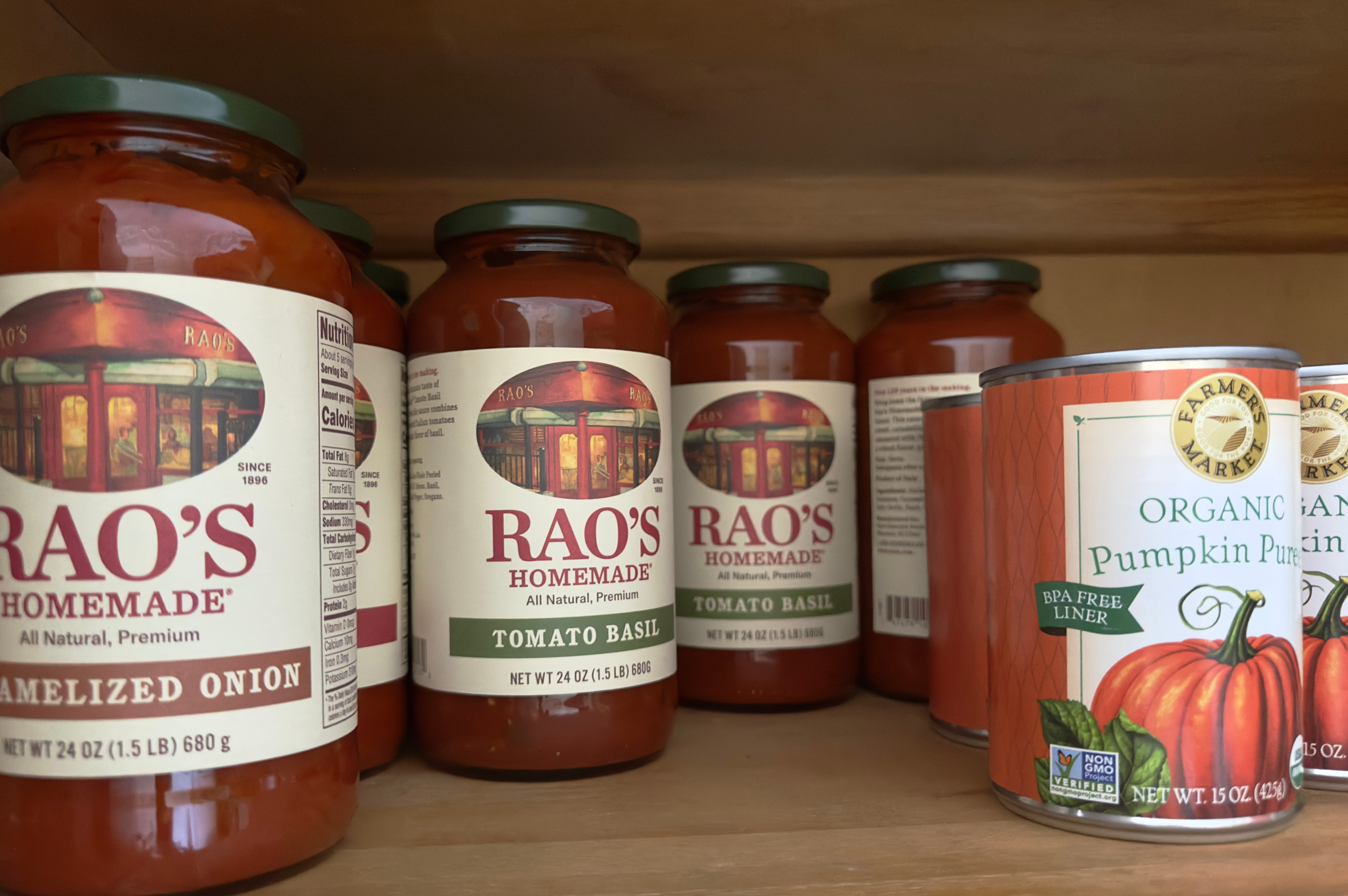
In short, the dingbat has learned to take note when Andy or I say something like “Oh! We’re almost out of honey/ pasta sauce/ canned pumpkin!”, and they’ve gotten good about ordering more. But, like the hapless Big Anthony in Strega Nona, the dingbat doesn’t know when to stop ordering it. Instead, all future grocery orders include at least one of the item the dingbat remembers us as being almost out of until Andy finally says, “My love, stop ordering pasta sauce!”, which (fortunately) works like Strega Nona’s blowing three kisses to the pasta pot and stops the cycle, so we don’t actually get buried in excess food staples. (It is good, however, that we live in a house with ample storage space. If we were still in a NYC apartment, we’d probably have jars of pasta sauce neatly lined up under our bed by now.)
That said, my overall ability to function has definitely improved from two years ago. I have successfully packed a suitcase several times now; I can read books without needing to stop every ten pages to let my brain buffer; I can even (sort of) worry again. (All bets are off when I’m in the middle of a VZV flare-up, though.)
It’s unclear to me exactly how much of this improvement comes from my brain healing and how much stems from the compensating techniques and/or work-arounds embedded in the new rhythms of my life, but I suppose those things aren’t entirely separable. I order groceries and have them delivered, for instance, via an app that shows me everything I’ve ordered before, so I can go through that list and just click items we need again. (Variety may be the spice of life, but that’s what Andy’s in charge of when he runs errands on the weekends - what the dingbat and I provide are the staples of our diet at appropriate intervals, thank-you-very-much.) My morning medications are lined up in a particular order in the cupboard so that I work from left to right (stopping at the tall bottle because the one bottle beyond that is for the evening), and I always take them the first time I get up to use the bathroom.
Not surprisingly, there’s no ‘one simple trick’ that works for me. Using the Notes app on my phone to keep track of important information (a technique recommended in our group therapy seminar), e.g., is useless for anything other than creating a historical curiosity to discover the next time I go to write something I want to remember in Notes, at which point I think, “Oh right! This is why I shouldn’t write important things in Notes!”…only to find some vital piece of long-lost information there again the next time I open the app. (Out of curiosity, I just opened up Notes to see what’s there and found the name of the eco-friendly weed-killer I’d been looking all over for back in October, as well as the brilliant idea I’d had for a Christmas present for Andy which I’d been trying to remember. Also, a note that just said “1993”. No context, no further information.)
Instead, the dingbat relies on a pastiche of techniques. One of Andy’s goddaughters taught me that you can check off little boxes next to ingredients when you’re looking at a recipe on your phone, which has been very useful for not leaving the pumpkin out of my pumpkin bread. But what’s been even more useful is learning to stick to ultra-forgiving recipes: lots of vegetable stews, lentil and rice dishes, roasted sweet potatoes, etc. - anything that doesn’t get fussed if you add ingredients at slightly random times and that tastes better if you forget about it for a while. (Seriously, if you like sweet potatoes, wrap them in tinfoil and let them bake in your oven at 325-350 F for anywhere between 1.5-3 hours. They’re extremely delicious anytime after 90 minutes, and I can attest that they will still be completely fine even after 3 hours, which is longest I’ve forgotten about them so far. If your memory isn’t so good, though, I strongly advise you NOT to make hard-boiled eggs unless you’re doing something that will keep you in the kitchen until they’re finished, because the stench of eggs that have boiled dry and are about to explode in a sulfurous cloud is second only to the stench of such eggs that have actually exploded.)
Every now and again, I’ll try something new and more complicated, like last month when I decided to make savory leek bread pudding for a clothing swap/potluck. The recipe seemed simple enough, and the dingbat carefully ordered everything I needed from the store while looking at the recipe, so I went in with high confidence. One pan of painstakingly caramelized leeks, bowl of grated Emmental cheese, and baking tray of cubed and toasted brioche later, however, and I was lying on the kitchen floor yelling desperately for Andy. The dingbat had gotten flustered following the (unnecessarily elaborate) instructions for the leeks, and so it hadn’t clocked that all ten cups of cubed bread weren’t going to turn over neatly for toasting no matter how large a tray I put them on, and several pieces duly fell onto the bottom of the oven - at the very back, of course - and started to burn. And then I forgot how hot the bottom rack would be and burned my hand on it fishing for the pieces with a big wooden spoon, and suddenly everything was too loud and too bright and too much, and I couldn’t handle it. Hearing the panic in my voice, Andy came running in ready to put out fires or bandage me up, but all I really needed was him to be there with me for a minute or ten while I pulled myself slowly back together. (I’ve said this before, and I’ll say this again, but I empathize with toddlers on such a deep level now.) I was basically done with the recipe - everything was ready for assembly - and so after I collected myself, I had him just stand there and let me tell him what I was doing as I layered the cheese with the leeks and now-golden bread into two loaf pans and poured creamy liquid over them. And then he took care of timing the baking while I went and laid down upstairs with a pillow over my head. The end result was delicious, but Andy and I ended up having to eat all of it because I was so drained from what was only supposed to be an hour-long prep that I couldn’t manage going to the clothing swap/potluck.
In retrospect, it was silly to attempt a completely new recipe on the same day I was supposed to attend a chaotic (albeit fun!) event, but not overdoing it when I’m feeling good has been one of the very hardest lessons to learn. “What do you mean the energy I have right now is supposed to last me ALL DAY?! Isn’t it going to regenerate as I go along, like it used to?”
As my neuropsych therapist always says when I tell her stories like this, “We can take this as a data point and work from here.” When I asked her whether I’d get better at making complex recipes if I kept trying them, she said that if I kept making the SAME complex recipe over and over again, I’d get better at it because repetition would build mental muscle-memory, but that the strategy was unlikely to make me better at complex recipes in general. (Then, because she could tell that this was also a sneaky way of asking whether she thought I was going to stay stuck where I am, she said, “But in your case I never rule things out!” In short, she is the best, and I love her.)
In non-food-related news, I am happy to report that reading has become much easier, especially since my brain stent. I listen to audiobooks basically every day, but I’ve reading more and more books with my eyeballs, too, and I’ve long since graduated from Wings of Fire and moved on to Agatha Christie mysteries, T. Kingfisher novels, and short story collections. I’ve even gotten to the point again where I can skim passages with which I’m bored or annoyed! (*cough* I’m looking at you, characters who can’t communicate their way out of a paper bag and thus spend pages of exposition fretting about things that could be cleared up in a two-minute conversation. *cough*) I may not be up to complex non-linear plots or professional philosophy papers, but this still constitutes a massive improvement over the stage at which I had to focus grimly on each word in turn long enough for it to string together with its fellows in a way that made sense. And it may be true that if I read a physical book for too long, I wake up the next morning feeling like I’ve got a hangover (nauseous, dizzy, horrible headache), but the hangovers have been feeling less severe as time goes on.
I’ll talk more about where I am with “losing my words” some other time, but the short version is that this is something that varies wildly depending on time of day, context, and subject matter. Leaving a voice mail usually reduces me to long pauses, weird tangents, and unnecessary repetition (and I’m not even a Millennial!), so I avoid it at all costs, but ask me about Thomas Aquinas’s view on angelic cognition and I can chatter happily with nary a stumble about his general position and who says what in the 20th-century controversy over whether it changes over his corpus. (This is apparently not just because that’s all grandfathered into my long-term memory but also because it’s information I ‘overlearned’ via research and teaching - a term of art in psychology that sounds amusingly paradoxical to most philosophers.) I almost never have trouble expressing what I thought about a book at the monthly meetings of Cake and Dagger, but then Andy will ask how it went, and I’ll go through “sandal”, “string”, and “shoe” before I manage to say that I got my favorite seat again (next to Deb and close to Scott). And ask me to go around the room naming objects and I get hung up every fourth or fifth object while my brain spins searching for the name: “Chair, table, candle, pillow…um…um…blanket.”
Suffice it to say that I understand my dingbat executive assistant much better at this point, and vice versa. She’s gotten better at her job in a number of ways as she’s gained experience, and (at least as importantly) I’ve gotten better about knowing what I can and can’t rely on her for - and what I can and can’t rely on myself for with her steering the wheel. I’d love to describe our interactions as a strange and delicate dance, but it’s more a hilariously awkward romp.
It’s the end of the day, and the world around us continues to crumble and burn; I post this with love for all of you and - until next time - a reminder to be extra-nice to your noggins.
Some of this executive dysfunction will be familiar to those with ADHD, like me. I didn't know but now it makes perfect sense that motivation belongs with it, too. The quiet of not worrying --because you literally can't-- (different post, but I just read that one too) is right on. What stuck with me is how you describe the dingbat assistant without trashing them. You still love this assistant. That's a great model for me. Thank you for sharing, and sharing so beautifully!
The last time I laughed so much was when I read your previous posts. So hilarious, yet deeply serious and moving. Yesterday, I cooked some salmon. Oven normally 180C, but salmon 200. Check dials, insert salmon. Towards end of cooking process look at dial ... pointed to 180. As someone who once had a fairly high functioning Dingbat that has been sliding so slowly into senescence I can't, of course, really imagine what it's like to go from super-efficient to worse than me virtually overnight, but I can understand the frustration etc. I only wish I had your sense of humour. But I do like the idea of being kind to your Dingbat.